The Twelve-Month Transformation: A First-Time Adopter's Honest Chronicle of Life with a Retired Racer
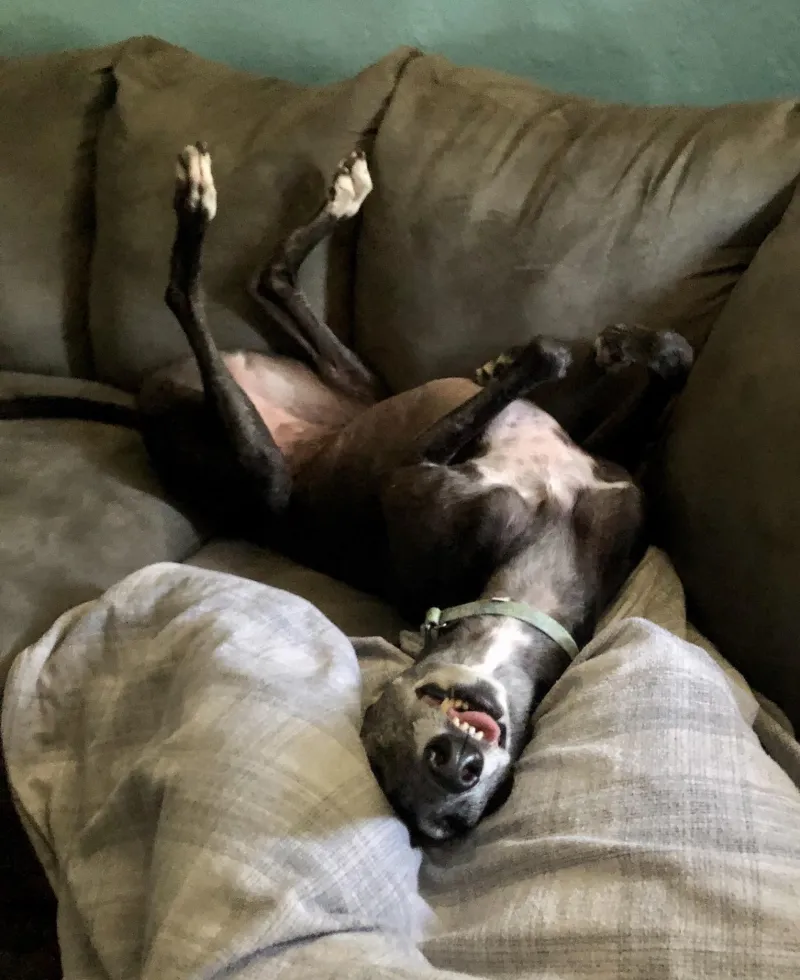
Photo: retired greyhound lying upside down on living room couch roaching, via i.redd.it
A Dog That Didn't Know How to Be a Dog
When Karen and Tom Henderson signed the adoption paperwork for a four-year-old retired racer named Pearl, they expected the process to resemble every dog adoption they'd seen on television: excitement, tail wags, instant companionship. Instead, their first night, Pearl stood frozen in the corner of their Columbus, Ohio living room for nearly two hours before lying down on the hardwood floor — nowhere near the plush orthopedic bed they'd bought her.
"We thought we'd broken her somehow," Karen recalls with a laugh. "Our adoption coordinator told us, 'Give her three days, three weeks, and three months.' We had no idea what that meant until we lived it."
That timeline — often called the 3-3-3 rule by greyhound adoption groups — is the unofficial roadmap for the thousands of American families who welcome retired racing greyhounds into their homes each year. And according to coordinators across the country, the families who understand it are the ones who succeed.
The Myth of the 45-MPH Couch Potato
Greyhounds carry a peculiar reputation: the fastest dogs in the world who also happen to sleep twenty hours a day. The "45-mph couch potato" nickname is affectionate, but it can mislead first-time adopters into thinking the transition is effortless.
Diane Whitfield, who has coordinated placements for a Midwest greyhound adoption program for over fifteen years, says the biggest rookie mistake is overstimulation. "New adopters want to show their greyhound the whole world in week one — neighbors, dog parks, the grandkids, a trip to the lake. These dogs have lived in kennels their entire racing careers. Everything is new. The stroller of a toddler, the ceiling fan, the mirror — it's all brand new to them."
The Hendersons learned this the hard way when a vacuum cleaner sent Pearl bolting down the hallway in a panic. "We felt terrible," Tom says. "But our coordinator reminded us she'd never seen one. Imagine that. Four years old, and a vacuum was science fiction."
Months One Through Three: Learning to Live Indoors
The earliest weeks of greyhound adoption revolve around basics that other breeds take for granted. Many retired racers have never encountered stairs, sliding glass doors, or reflective floors. House training, surprisingly, is rarely the issue — greyhounds are kennel-trained and naturally clean — but navigating a home's geography takes patience.
The Hendersons taped pool noodles to their coffee table corners and gated off the staircase until Pearl learned to climb with confidence. They fed her in a quiet room. They resisted the urge to invite every friend over to meet her.
"The rule in our house became 'let the dog decide,'" Karen explains. "When Pearl chose to approach you, that was the win."
Milestones came slowly and then all at once. The first voluntary tail wag arrived in week five. The first play bow — that unmistakable downward stretch greyhound owners call the "roaching prelude" — came in month two. By month three, Pearl had claimed the sectional couch as her own, sleeping in the dramatic upside-down sprawl enthusiasts call "roaching," legs bent skyward like a fallen insect.
"The day she roached on the couch, I called my mother," Tom says. "I'm not exaggerating. It felt like a graduation."
Months Four Through Nine: The Greyhound Emerges
Somewhere in the middle of the first year, most greyhounds shed their reserve. This is the period, coordinators say, when adopters often make their second most common mistake: relaxing boundaries too soon.
"Month five is when people decide their greyhound is fine off-leash at the park," Whitfield warns. "Greyhounds are sighthounds. They can spot a squirrel at four hundred yards and hit full speed in three strides. No recall training will outrun that instinct. A fenced area or a leash, always. We've had too many heartbreak calls."
The Hendersons instead channeled Pearl's athleticism into structured outlets — morning walks through their neighborhood metropark, and eventually a local lure coursing fun day hosted by a regional sighthound club. Watching Pearl run flat-out for the first time, months after her retirement, moved Karen to tears.
"She'd been a professional athlete her whole life," Karen says. "That first sprint in the field, you could see her remember who she was."
Months Ten Through Twelve: Advocates, Accidentally
By their first anniversary, the Hendersons had become what adoption groups call "breed ambassadors" — the families who show up at meet-and-greet events, answer questions from curious strangers, and eventually convince friends to adopt.
"Nobody sets out to be an advocate," Whitfield says. "It happens because people fall in love with a dog they almost didn't understand, and they want to make the path easier for the next family."
The Hendersons' advice for prospective adopters is practical: apply through a reputable adoption group, ask about the dog's personality profile, invest in a raised feeder and an orthopedic bed even if the dog ignores both at first, and prepare for a quiet first month.
Pearl, now five, sleeps on the couch as this article is written. Her racing record — 62 starts — is memorialized in a frame above the fireplace. Her future is measured not in fractions of a second but in Saturday mornings.
"People ask us if adopting a greyhound is hard," Tom says. "It's not hard. It's just slow. And then one day, a year in, you look over and there's this long, elegant creature asleep upside down on your furniture, and you can't imagine your house without her."
For the Greyhound Club of America's adoption community, that is the whole story in a single image: a former racer, home at last, roaching on a couch in Ohio.