Beyond the Ribbon: Inside the Minds of the Judges Who Read a Greyhound in Thirty Seconds
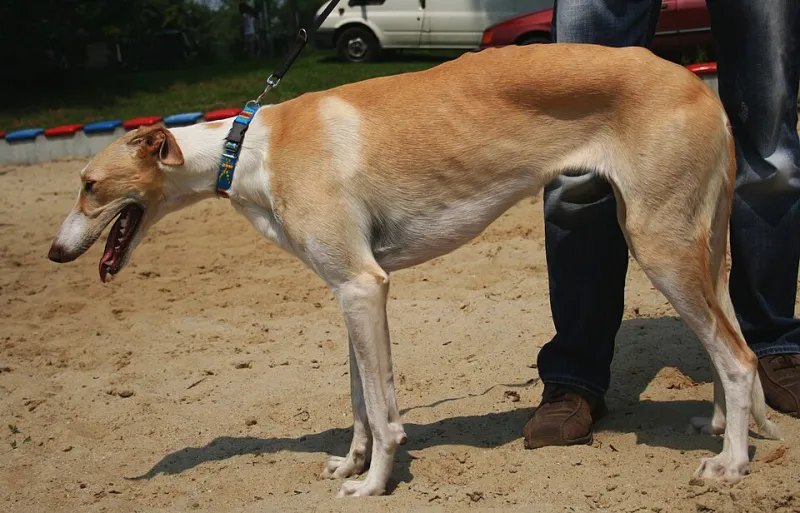
Photo: Pleple2000, CC BY-SA 3.0, via Wikimedia Commons
To the untrained eye, a lineup of greyhounds in the conformation ring can look like a study in sameness. Sleek, athletic, elegant — how does a judge possibly distinguish one from another in the minute or two each dog gets on the table and the ground?
The answer, according to the judges and handlers we spoke with, is that a seasoned eye doesn't just look at a greyhound. It reads one.
The Standard as a Blueprint, Not a Checklist
The AKC's official standard for the greyhound runs roughly 900 words, and judges are quick to note that it rewards balance above all else. "The standard doesn't say 'longest neck wins' or 'tightest tuck wins,'" explains a longtime breeder-judge from the Midwest circuit. "It says the greyhound should convey 'great courage and endurance.' Every measurement has to exist in harmony with every other."
That harmony is the through-line of the breed standard. The greyhound is built for the sustained pursuit of game at speed — the standard repeatedly references this function. Judges aren't evaluating fashion; they're evaluating engineering.
Anatomy: The Pieces That Add Up
Ask three judges what they examine first and you may get three different answers, but certain elements come up again and again.
The head and expression. The standard calls for a skull "rather long and narrow" with a distinct stop — or more accurately, the near-absence of one. Judges describe the correct head as an extension of the silhouette rather than a departure from it. Ears should be small and folded back in a rose shape; the eyes dark, intelligent, and full of that characteristic soft alertness.
The forequarters. Shoulders are a frequent tiebreaker. The standard asks for shoulders "placed as obliquely as possible" — a phrase that puzzles newcomers but makes perfect sense to judges. A well-laid shoulder allows the length of stride the breed requires. A straight, upright shoulder shortens the reach and, in a judge's mind, undermines the entire premise of the dog.
The body and underline. The deep chest, the pronounced tuck-up, the arched loin — these aren't aesthetic flourishes. They're the visible architecture of a sighthound's respiratory and locomotor systems. "When I run my hands down a dog," one judge told us, "I'm confirming what my eyes already suspected. Is the chest deep enough? Does the topline flow, or does it break?"
Hindquarters and angulation. The hindquarters should mirror the forequarters in strength and angulation. A greyhound with a powerful rear but a weak front is, in judging parlance, a mismatch — impressive at the stand-still, wrong in motion.
Movement: Where the Verdict Is Usually Decided
If stacking and table examination narrow the field, gait decides it. The standard is emphatic: movement should be "free, the hind legs having good reach... the action true, straight and vigorous."
Judges watch for a double-suspension gallop's conformation cousin: a driving, ground-covering trot in which the dog's topline remains steady and the tail — the long, low, whip-like tail the standard requires — acts as a visible rudder. Dogs that crab, weave, or move with a choppy front-and-rear cadence are showing the judge that something in the construction doesn't add up.
"I've put up a dog that didn't 'show' as flashily as its competition purely because of its down-and-back," one judge admitted. "On the away and toward approach, you see the truth. You see whether the dog converges properly, whether the pasterns hold. Movement doesn't lie."
Temperament: The Quiet Criterion
Conformation judging is not a temperament test, but the greyhound standard explicitly demands a disposition that is "even, affectionate" — and judges notice when it's absent. A greyhound that cowers on the table, glares at the judge, or refuses to gait is presenting a picture that no amount of conditioning can repair.
Top handlers agree. "You can't fake a greyhound's presence," says a handler with multiple group placements to her credit. "The great ones walk into that ring and own it. That self-possession is part of the breed."
Why It Matters Beyond the Ring
For newcomers — especially adopters of retired racers who attend their first kennel club show out of curiosity — understanding the standard reframes the entire event. Judges aren't picking the prettiest dog; they're identifying the animal best constructed to do the job the breed was created for. Every champion crowned at a specialty or at the Greyhound Club of America's national specialty is, in theory, a living endorsement of the breeding decisions behind it.
And that has consequences far beyond the ribbon. The dogs judged best today shape the litters of tomorrow, and the health, soundness, and temperament of the breed for a generation. It's a responsibility the best judges carry lightly but never forget.
"When I point to a greyhound," one of our interviewees said, summing it up, "I'm not just saying I like this dog. I'm saying: this is what a greyhound should be. Remember it."
That, in the end, is what the standard is for — and why decoding it is worth the effort for anyone who loves this breed.