Beyond the Rail: A Practical Guide to AKC Sports for Retired Racing Greyhounds
Every retired racer arrives with a story written in speed: a sprinting athlete accustomed to routine, handling, and the roar of a crowd. It is natural for adopters to wonder whether that hound might enjoy a second career in the AKC ring. The answer is encouraging but conditional. Some retired racers are genuine candidates for conformation competition; many more can thrive in performance events. In every case, the hound’s welfare should set the pace.
The Greyhound Club of America’s interest in this question is straightforward. The breed standard describes a hound of balance, power, and elegant outline, and retired racers are Greyhounds in every sense. Yet the show ring is not a rescue victory lap. It is a structured evaluation governed by registration rules, presentation standards, and the judge’s reading of breeding stock. Adopters who understand that distinction can pursue dog sports with clear eyes.
Begin With Paperwork, Not the Comb
The first question is not whether a retired racer can stack or gait. It is what registration the hound holds. Many racers carry National Greyhound Association papers rather than AKC registration. The AKC does provide pathways for eligible purebred Greyhounds, but eligibility depends on documentation, pedigree, and the specific event. Adopters should verify the current process directly with the AKC and seek guidance from GCA before assuming entry is possible.
A common misconception is that a retired racer can simply be entered in conformation because the dog is visibly purebred. AKC conformation requires individual AKC registration. The AKC Purebred Alternative Listing, often called PAL, can open certain performance events to purebred dogs that are not otherwise AKC-registered, but it does not grant access to the breed ring. That distinction matters. An adopter who dreams of Best in Show must confirm full registration eligibility; an adopter who wants agility, obedience, rally, or coursing may have a broader path.
What the Rulebook Says—and What It Does Not
The rules are neither a locked gate nor a rubber stamp. They are a framework. A retired racer is not automatically ineligible for AKC competition, nor is an NGA tattoo a free pass to the conformation ring. The breed standard is the same standard applied to every Greyhound: a combination of balance, symmetry, muscular power, and refined outline, with movement that reflects soundness and efficiency.
What the rulebook does not do is measure desire. A hound may be structurally correct and still dislike the ring. A hound may be registered and still lack the conditioning or temperament for crowded show grounds. GCA mentors therefore look beyond paperwork. They watch how the dog stands, moves, recovers from handling, and responds to new environments. Those observations are not formal eligibility criteria, but they are practical ones.
The Mentor Advantage
Breed club mentors are invaluable because they translate abstract rules into realistic next steps. A GCA-affiliated mentor can help an adopter assess conformation potential, locate nearby matches or sanctioned entries, and understand what judges expect in the breed ring. Mentors also tend to be candid about limitations. A retired racer with a coarse coat, inefficient movement, or a retiring temperament may be a wonderful companion but not a conformation prospect.
This is not discouragement. It is stewardship. The breed ring exists to evaluate breeding stock, and the performance ring exists to test teamwork and function. Both can honor a Greyhound’s heritage without turning every adoption into a competitive obligation.
Conditioning the Ex-Racer
Race conditioning and show conditioning are not the same. A racer is trained for short, explosive efforts; a show dog needs sustained stamina, balanced muscling, and the ability to stand calmly for examination. Adopters should begin with a veterinary clearance, a dental review, and a honest conversation about weight and coat. Retired racers are often lean, but the breed ring rewards fitness, not thinness.
Conditioning should be gradual. Controlled leash walks, gentle hill work, and short training sessions build strength without overwhelming a hound whose body is still adjusting to retirement. Nails, teeth, and coat deserve early attention because presentation begins long before the handler enters the ring.
Ring Presentation and the Greyhound Standard
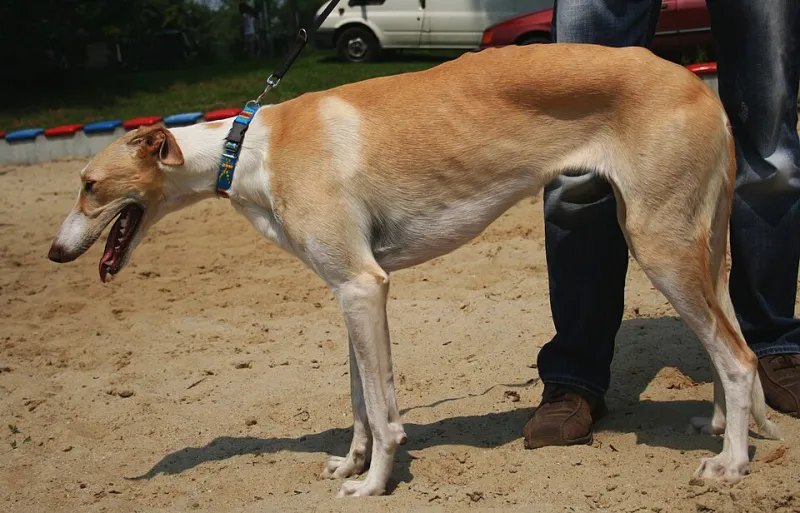
The Greyhound standard describes a hound that is both powerful and elegant. In the ring, that translates to a natural, balanced stack—not an overhandled caricature. The handler should allow the hound to stand with dignity, showing outline and topline without forcing the head or stretching the frame. Movement should be steady and efficient, demonstrating reach and drive without racing.
Judges read the whole dog: silhouette, condition, temperament, and gait. A retired racer’s race record is irrelevant here. What matters is whether the hound reflects the standard and can be examined comfortably. Adopters should practice examination at home, reward calm acceptance, and avoid turning ring preparation into a pressure campaign.
Performance Events as a Bridge
For many retired racers, performance events are the more natural second career. Agility, obedience, rally, and AKC coursing tests reward teamwork and enthusiasm. Fast CAT and Coursing Ability Tests can appeal to a hound’s love of the chase in a controlled setting. These events may be accessible through PAL for eligible purebreds, and they offer a lower-barrier introduction to competition.
Performance sports also teach adopters how their hound learns. A dog that finds the conformation ring stressful may blossom in agility. A dog that dislikes repetition may enjoy lure-based events. The point is not to force one path but to find the one the hound can enjoy safely.
Welfare First, Ribbons Second
A retired racer’s temperament is famously adaptable, but adaptability is not unlimited. The show ring should not become a second job. Signs of stress—freezing, avoidance, excessive panting, reluctance to be examined—should be taken seriously. GCA’s perspective is that a confident companion is a greater achievement than a reluctant ribbon winner.
A Step-by-Step Roadmap
- Confirm registration eligibility with the AKC and GCA before entering any event.
- Obtain veterinary clearance and address dental, coat, and nail care.
- Attend a match show or sanctioned event as a spectator to assess the environment.
- Seek a GCA mentor who can evaluate conformation potential honestly.
- Condition gradually and practice calm examination at home.
- Consider performance events first if conformation eligibility is uncertain.
- Reassess often. The hound’s comfort should determine the next step.
The retired racer who enters the AKC world does not leave the track behind so much as bring its lessons forward: discipline, adaptability, and a remarkable willingness to work with people. The best second career is the one the hound chooses—and the one its adopter supports with patience, paperwork, and welfare at the center.